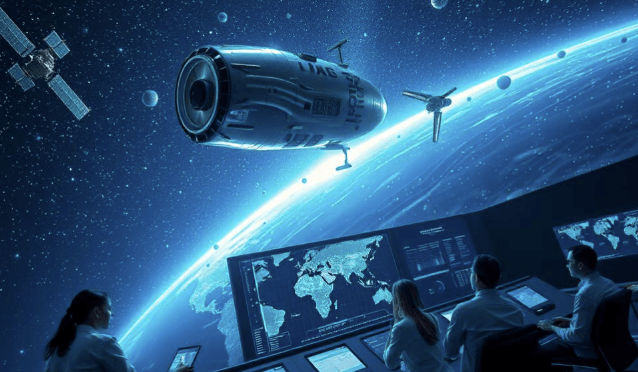
AI in space technology enables autonomous decision-making and resilient navigation across missions. It supports real-time data analysis, anomaly detection, and trajectory optimization, while wearables and onboard sensors yield risk-aware insights for crews. Transparency and auditing grow as governance matures, enabling safer operations under tight timelines. The interplay of ethics, fault tolerance, and data governance raises questions about autonomy limits and verifiable safety margins, inviting further examination of how such systems will shape future expeditions.
What AI Powers in Space Systems
AI underpins a broad range of functions in space systems, enabling autonomous decision-making, resilient navigation, and real-time data analysis. The architecture supports adaptive fault tolerance, onboard anomaly detection, and mission-specific optimization. Researchers examine AI ethics implications for autonomy, accountability, and safety.
Space wearables integrate biometric monitoring with AI inference, informing crew-centric risk assessment and ergonomic design while preserving operational clarity and freedom in exploration.
How AI Elevates Space Mission Operations
In space mission operations, AI-driven systems enhance decision cadence, fault isolation, and trajectory optimization by delivering autonomous assessments under tight timelines and limited human-in-the-loop involvement.
These capabilities support space autonomy and enable rapid interpretation of mission data, translating complex sensor streams into actionable guidance.
The result is safer, more efficient operations, with transparent rationale and auditable decision processes for mission planning.
AI for Space Data, Wearables, and Autonomy
How can machine-driven insight transform space data streams, wearable telemetry, and autonomous systems to reduce latency and increase situational awareness? AI enables onboard ML processing, anomaly detection, and health monitoring, accelerating satellite imaging analysis and attitude control.
Data governance and AI ethics shape trustworthy deployments for autonomous rovers, wearables, and ground stations, clarifying responsibility and performance boundaries in dynamic space environments.
Navigating Risks, Ethics, and Future-Frontier AI in Space
The shift from onboard data processing and autonomy toward governance, risk management, and future-frontier AI in space introduces a disciplined framework for responsibility and reliability.
This examination analyzes risk governance structures, accountability rails, and ethical deployment criteria for autonomous systems, satellites, and probes.
It stresses transparent decision logs, verifiable safety margins, and continuous auditing to sustain freedom with rigorous technical scrutiny.
Frequently Asked Questions
How Is AI Trained for Extreme Space Environments?
AI training for extreme environments employs simulated physics, fault injections, and autonomy testing to expose agents to rare events; risk mitigation follows, refining decision-making. Techniques emphasize robust perception, control under radiation, thermal stress, and communication latency.
What Are Cost-Benefit Considerations for AI in Missions?
Cost-benefit calculus weighs mission gains against up-front, lifecycle costs, with risk mitigation shaping design choices; AI reduces human risk and enhances autonomy, yet introduces integration, validation, and reliability burdens that influence budget, schedule, and scientific returns.
How Does AI Handle Communication Delays in Space?
AI handles communication delays via autonomous comms, maintaining operations despite latency. It leverages AI latency awareness, AI fault tolerance, and adaptive scheduling, enabling robust data exchange; the system remains curious, precise, technical, and suitable for an audience seeking freedom.
Can AI Ensure Long-Term Data Integrity and Provenance?
AI can enhance long-term data integrity and provenance, but unknowns persist; ethics must guide implementations, ensuring checksums, tamper-evidence, and auditable provenance while balancing autonomy and freedom within robust, verifiable, and transparent data governance frameworks.
See also: asjreflet
What Governance Frameworks Guide Space AI Deployments?
“The framework? They rely on established space governance standards, with ethical oversight and risk assessment embedded.” The discussion describes transparent accountability, cross-border collaboration, and adaptive compliance, aiming for principled autonomy while permitting exploratory deployment in open, freedom-loving operational cultures.
Conclusion
The integration of AI across space systems promises heightened autonomy, resilience, and data-driven decision-making, enabling more efficient missions and safer operations under tight timelines. While autonomous fault handling and trajectory optimization reduce human workload, transparent rationale and robust governance remain essential to trust and accountability. As exploration expands, AI will serve as a steady navigator, but only if ethical, auditable frameworks keep pace with capability—never letting ambition outstrip safety, lest progress get burned. In short, careful governance tames wild potential.