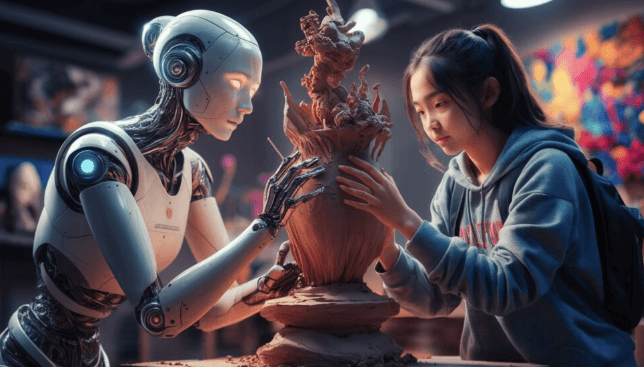
AI innovation is shifting from simple automation toward collaborative creativity. Machines become partners that reveal new ways to solve routine problems and spark inventive answer sets. The aim is practical progress guided by lightweight experiments and transparent feedback. Trust and shared purpose scale these efforts, turning humans and systems into co-creators of useful breakthroughs. Governance and culture will determine how far this partnership can travel, and what responsible transformation will feel like in real work. The next step awaits.
What AI Creativity Really Means for Everyday Work
AI creativity in everyday work redefines what teams can achieve by turning routine tasks into opportunities for inventive problem-solving.
The perspective frames AI as a facilitator, not a substitute, guiding collaboration toward practical outcomes.
Idea one emphasizes lightweight experimentation; idea two anchors feedback loops.
Teams gain autonomy, prioritize value, and design processes that scale with trust, transparency, and shared purpose.
Breakthrough Examples: Machines Co-Creating With Humans
Breakthroughs arise when humans and machines share the creative load, co-authoring outcomes that neither could achieve alone. In real-world experiments, teams harness collaborative invariants to align goals while preserving human intuition, enabling scalable, responsive design. Projects celebrate serendipitous authorship, where unexpected prompts spark novel solutions. The result is a pragmatic, forward-looking partnership: freeing creative potential through disciplined collaboration, transparent processes, and audacious shared vision.
How to Measure AI Creativity: Metrics and Ethics
How can creativity in AI be assessed in a way that guides progress without stifling innovation? The article examines ethics metrics and creativity benchmarks, framing evaluation as a collaborative, forward-looking practice. It emphasizes transparent criteria, diverse perspectives, and ongoing dialogue between developers and users. Measurements balance novelty, usefulness, and responsibility, enabling responsible freedom to explore while guarding against harm and bias.
From Tools to Transformation: Implementing Creative AI Responsibly
From tools to transformation, responsible implementation of creative AI requires a purposeful bridge between capability and consequence. The discourse emphasizes two word discussion ideas and subtopic relevance, guiding organizations to codify governance, ethics, and collaborative design.
Vision meets pragmatism as teams align incentives, safety, and creativity, crafting scalable processes.
Freedom-loving minds pursue transparent experimentation, continuous learning, and shared accountability for transformative outcomes.
Frequently Asked Questions
How Can Ai-Generated Ideas Be Protected by Intellectual Property Laws?
AI-generated ideas can be protected through AI licensing agreements and clear copyright ownership assignments, balancing inventor rights with societal access; this pragmatic, visionary framework invites collaboration, ensuring freedom to innovate while defining stewardship and accountability for creators and users.
Will AI Creativity Replace Human Jobs in Creative Industries?
AI creativity may impact some roles, but it will not fully replace human artistry; collaboration yields new opportunities. Visionaries should mitigate Job Displacement with adaptive training, ethical frameworks, and shared platforms for AI-assisted creativity, fostering AI vs Creativity synergy.
Can AI Creativity Be Truly Original or Just Recombinations?
A case study: a collaborative music platform uses AI originality to blend disparate genres, revealing potential beyond pure recombination. AI originality shows promise, yet recombination limits pose boundaries; creativity thrives when humans steer intent and interpretive meaning.
What Are the Risks of Bias in AI Creative Outputs?
Bias in outputs rises from flawed data provenance, model assumptions, and feedback loops, risking narrowed creativity and unjust conclusions. A pragmatic, collaborative approach demands transparent data provenance, diverse evaluation, and shared governance to preserve freedom and trust in AI.
See also: AI in Space Technology
How Do We Ensure Consumer Trust in Ai-Created Content?
In a coincidence of trust risk and transparency, the report asserts that consumers sustain faith when creators disclose data use, intent, and standards; originality debate fades through verifiable lineage, collaborative governance, and pragmatic, freedom-preserving guarantees.
Conclusion
In the end, creativity isn’t a flashy gadget; it’s a disciplined duet. Machines propose, humans choose, and together they draft the future one experiment at a time. This satire of automation reveals a practical truth: clever tooling accelerates collaboration, not replaces it. When governance, ethics, and transparent feedback loop like a compass, creative AI becomes a scalable platform for real-world impact. Visionaries choreograph, pragmatists implement, and everyone benefits from accountable, co-authored breakthroughs.