Good sauna and cold-plunge guidance around sweat Decks should sound like someone has actually installed and used the setup. Space, power, drainage, heat-up time, and routine all matter.
Last February, my neighbor Dave Kurtz, who lives about a quarter mile down our gravel road outside Duluth, Minnesota, lost power for 22 hours during a sleet storm. Temperatures bottomed out around negative eight. He texted me at 6 AM: “House is 48 degrees. Any chance your sauna works without power?” I told him to come over. By 6:45 we had a fire going, and by 7:30 we were sitting in 185-degree air, pouring water on stones while his furnace sat dead. “I’m ordering one of these this spring,” he said. He did.
The first three sauna brands I spoke with before buying mine tried to talk me out of wood-burning. “It’s more work.” “Electric is more consistent.” “Most of our customers go electric.” I went wood-burning anyway. Eighteen months in, zero regrets, and I’d make the same call again tomorrow.
Here’s the honest case, the honest tradeoffs, and who should ignore my advice entirely.
Three Reasons I Went Wood
Power reliability. I live rural. The grid works 95 percent of the time, but we lose power three or four times a year for stretches lasting 12 to 36 hours. Winter outages are the worst, obviously. A wood-burning sauna means the most reliable wellness tool in my house works regardless of what the grid is doing.
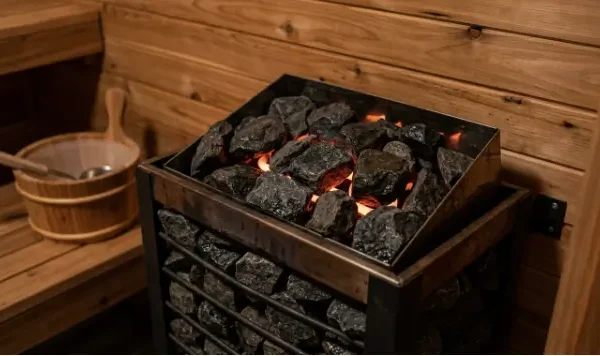
The fire ritual. This one is harder to put into words. Building a fire, smelling the smoke, hearing the crackle. An electric sauna is a clean appliance experience. A wood-burning sauna is closer to camping. Think of it like the difference between a gas range and cooking over charcoal. Both produce heat. One feeds something else in you.
Heat character. Wood-burning saunas produce a slightly different heat profile. The radiant component is higher because of the larger stone mass typically loaded on a wood stove. The dry heat combined with a steam burst from water on stones has a quality I find more satisfying than electric. More enveloping. Less clinical.
The brands that tried to talk me out of it weren’t lying about the tradeoffs. They were wrong about which tradeoffs mattered to me.
The Real Work Involved
Let me be specific, because vague warnings about “more maintenance” weren’t helpful when I was deciding.
Wood storage. I burn roughly half a cord of hardwood per year with daily use in a 6-person cabin. That’s about 64 cubic feet of split wood. I keep it in a covered wood shed 20 feet from the sauna door.
Kindling and fire starters. I keep a bin of dry kindling and a stack of waxed cotton fire starters on hand. Building the fire takes 3 minutes if your materials are dry. Significantly longer if you’re trying to light damp wood with newspaper (ask me how I know).
Time to preheat. 40 to 60 minutes from cold start. About the same as electric, but it requires you to physically walk out and build the fire, then check it.
Chimney maintenance. Once a year with a chimney brush. Takes 20 minutes. You could pay a sweep if you didn’t want to do it yourself.
Ash removal. Every 4 to 8 sessions, empty the ash pan. I dump mine in the garden. The whole process takes two minutes.
What You Don’t Need
No licensed electrician for the install. That’s the biggest upfront savings.
No 240V infrastructure. No permit for electrical work. No panel upgrade.
No concern about replacement heating elements on a 10-year cycle. A wood stove is simple steel and refractory brick. With reasonable maintenance it lasts decades.
No tracking electricity cost. The marginal cost of a session is whatever the wood costs, which for me runs roughly 75 cents to a dollar per session in hardwood.
Installation Costs, Itemized
I ordered a 6-person cedar cabin from Sweat Decks with the wood-burning heater option.
Sauna and heater package: $8,400
Chimney kit (insulated double-wall stainless steel, code-compliant): $480
Heat shield kit for the back wall behind the heater: $140
Spark arrestor for the chimney cap: $60
Permit for wood-burning appliance in my jurisdiction: $0 (not required where I live)
Concrete pad I poured myself: $300 in materials
Total install cost: $9,380
If I’d gone electric, the same sauna would have cost roughly $200 less for the heater package but added about $1,400 for the electrical install. Net savings going wood-burning: roughly $1,600.
Here’s the thing. In suburban contexts where electricians are expensive and wood storage is impractical, the math may flip. In rural contexts with abundant wood and expensive electrical infrastructure, wood-burning is almost always cheaper to install.
What a Typical Session Actually Looks Like
Electric routine: Hit the button on the wall controller. Walk away. Come back in 40 minutes. Sauna is at temperature. Use it. Walk away. Heater shuts off automatically.
Wood routine: Walk to the wood shed. Carry an armload of wood and a few pieces of kindling. Build the fire in the stove. Wait 5 minutes to make sure it’s caught. Close the air damper to slow the burn. Come back in 40 minutes. Sauna is at temperature. Add a log if you want a longer session. After use, let the fire burn down naturally. Empty the ash pan when it’s full.
Total extra time per session, wood versus electric: 4 to 6 minutes.
For some people that’s a deal-breaker. For me it’s part of why I prefer wood. The ritual is the point. Stripping it down to a button press would be like replacing your morning coffee pour-over with a Keurig. Technically faster. Missing something.
When I Actually Miss Electric
Twice a month. Maybe.
Mostly when I want a quick session and haven’t preheated. With electric I could hit a WiFi app from inside the house and start preheat 40 minutes out. With wood I have to physically walk out and build the fire.
In the depth of winter when I’m low on kindling and sourcing dry wood is a hassle.
When friends visit who don’t know how to feed a fire and we want to extend a session past the initial load.
That’s the full list.
Longevity: The Boring Truth
A quality electric sauna heater lasts 8 to 20 years. The element is the failure point. Most heaters can be re-elemented at a fraction of full replacement cost if the housing is still sound.
A quality wood-burning sauna stove lasts 25 to 40 years. The firebox bricks are replaceable. The steel doesn’t fail unless you’ve seriously abused it.
Over a 30-year ownership horizon, wood-burning likely costs less in heater replacement. It’s not a dramatic difference, but it’s real.
Sourcing and Storing Wood
If you’re rural with woodland, you can cut your own. A cord of hardwood split and stacked from your own trees costs basically your time plus chainsaw fuel.
If you buy wood, a cord of seasoned hardwood ranges from $200 to $500 depending on region. I burn half a cord a year, so wood cost runs $100 to $250 annually for daily sauna use.
Use hardwoods: oak, maple, hickory, birch, ash. Avoid softwoods like pine, which burn fast, produce more creosote in the chimney, and make your chimney cleaning intervals shorter.
Wood needs to be dry. Seasoned at least 12 months. Wet wood smolders, heats poorly, and gunks up the chimney. This is non-negotiable. I’ve watched people try to run a wood sauna on wood that was cut three months ago. It doesn’t work. You just get a smoky, lukewarm disappointment.
Safety, Specifically
Wood-burning saunas have specific safety considerations that electric models don’t.
Carbon monoxide. A properly installed chimney with good draft moves combustion gases up and out. A blocked chimney, downdraft, or backdraft can push carbon monoxide into the sauna. Install a CO detector inside. They cost $30 and might save your life. This is not optional.
Fire safety. Don’t operate a wood-burning sauna unattended. Keep a fire extinguisher near the door. Don’t leave the fire damper wide open if you’re not actively heating.
Burns from the stove. The stove body and chimney get extremely hot. Don’t touch them. Don’t dry towels on them. (I have a small scar on my forearm that reminds me of this.)
Sparks. A spark arrestor on the chimney cap is essential, especially in wildfire-prone areas. Some jurisdictions require them by code.
Children and pets. A wood stove in a sauna is a fundamentally different supervision context than an electric heater. The stove body is exposed and radiating serious heat. Plan accordingly.
Who Should Go Electric Instead
I’ll be direct: wood-burning isn’t for everyone, and pretending otherwise would be dishonest.
Suburban homeowners with neighbors close by who might complain about smoke. The smoke is mild but real.
Anyone without space to store half a cord of wood under cover.
People who genuinely want a “press button, walk away” experience and don’t enjoy building fires.
Apartment dwellers with rooftop or shared saunas. Wood-burning is not realistic.
People with respiratory sensitivities to smoke.
If you see yourself in that list, go electric. You’ll love it. No shame in it.
Who Should Go Wood
Rural homeowners with available wood and minimal neighbor proximity.
Anyone who values the ritual and the smell.
People in cold climates with unreliable power (this was the deciding factor for me).
People who want the classic Finnish sauna experience as authentically as possible.
Off-grid or partial off-grid setups.
People who want a heater that lasts 30-plus years with minimal electronics to fail.
My Advice If You’re on the Fence
Try a wood-burning sauna before you commit. At a friend’s house, at a wellness center, wherever you can find one. The experience is different enough from electric that 30 minutes in one will tell you whether you’d love it daily or find it tedious.
Don’t underestimate the wood storage requirement. It’s a real, ongoing piece of household logistics. Half a cord isn’t enormous, but it needs to be split, stacked, covered, and replenished.
Don’t underestimate the chimney maintenance. Not difficult, but recurring.
If your home has unreliable power, lean wood-burning regardless of personal preference.
If your home is suburban with HOA constraints and reliable power, lean electric.
If you’re rural with wood access, the question really comes down to whether you want the ritual or you want convenience. Both answers are perfectly fine.
Eighteen Months In
I’d make the same choice tomorrow. The fire-tending is a feature, not a bug. The reliability during power outages has justified itself multiple times over. The heat character is what I wanted.
And here’s my genuinely opinionated take: the sauna brands that tried to steer me toward electric were optimizing for their easiest-to-support product, not for my best experience. Electric saunas generate fewer support calls, fewer installation questions, fewer complaints from people who didn’t realize they’d need to source firewood. From the brand’s perspective, electric is the safer recommendation. But “safer for the brand” and “better for you” aren’t always the same thing.
Wood-burning is not for everyone. For the right person in the right setting, though, it’s the better choice. And 18 months of daily fires have only made me more certain of that.